
What Is a Plotted Development, and Why Does It Matter for Bangalore Land Buyers?
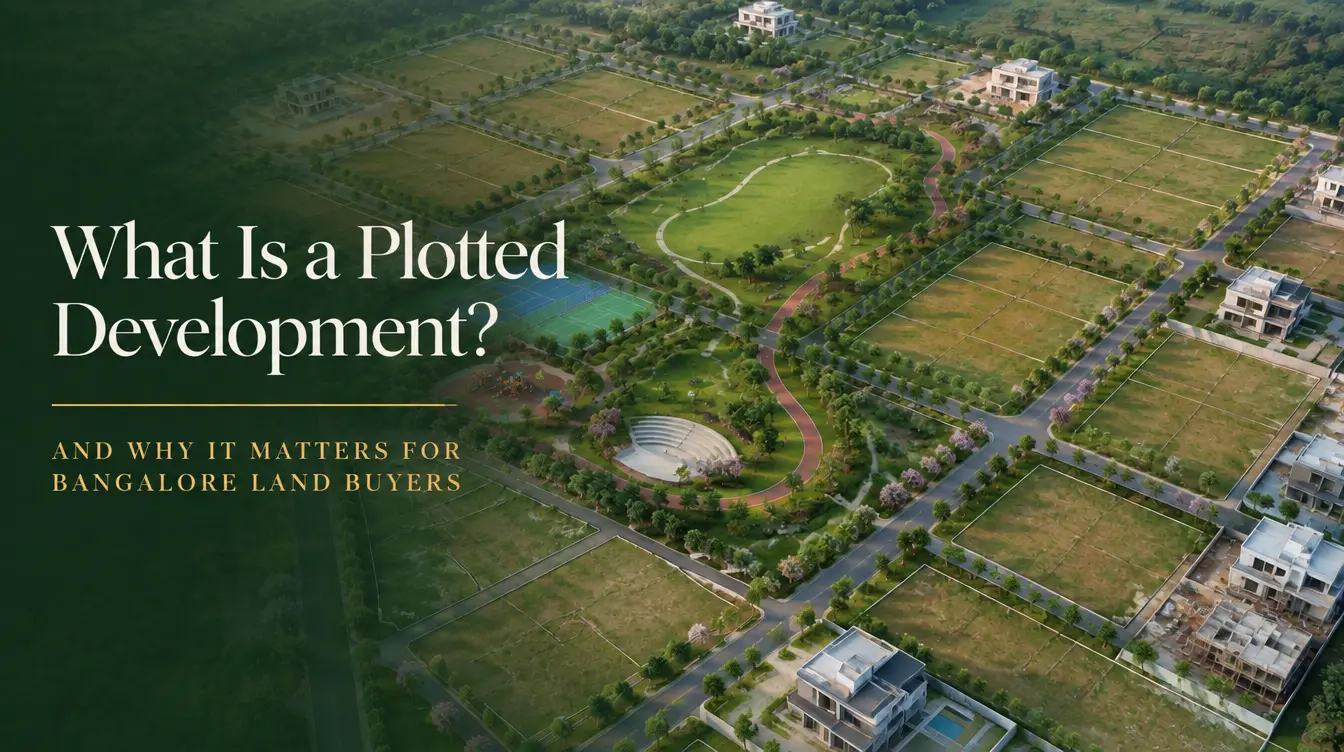
"Gated community" gets most of the attention in Bangalore's plot market, but the term that actually decides whether your investment is safe is a different one: plotted development. A plotted development is simply a piece of land that has gone through formal government approval to be subdivided into individual plots with roads, drainage, and utilities laid out before sale, whether or not it is walled and gated.
That distinction matters more than most buyers realise. A layout can be beautifully gated and still be unapproved. A layout can also be a legitimate, fully approved plotted development without a boundary wall or a security cabin. The wall tells you about the amenities. The approval tells you whether the land is legally safe to buy, build on, and eventually sell.
The more useful question, then, isn't "Is it gated?" It's: "Is this plotted development actually approved, and what does that approval get me as a buyer?"
What Makes a Layout a "Plotted Development" in the First Place
In Bangalore's regulatory framework, a plot only qualifies as part of a genuine plotted development once it clears a specific sequence of approvals:
- Land conversion (DC conversion): agricultural land converted for residential non-agricultural use, without which no legal residential layout can exist.
- Layout approval: sanctioned by the relevant planning authority (BDA, BMRDA, or the STRR Planning Authority, depending on jurisdiction, along with the local planning authority for that survey), which fixes road widths, plot sizes, and civic amenity areas on record.
- RERA registration: mandatory for most layouts above the threshold size, giving buyers a regulator-backed project record and defined delivery obligations.
- Khata and revenue records: clean RTC/Pahani history and a proper khata (A khata, ideally) that supports both loans and future construction sanctions.
None of this is guaranteed by a compound wall, a security guard, or a name that sounds premium. It is verified through documents. That is exactly why the label "plotted development" should prompt a paperwork check, not put you at ease on its own.
Where a Genuinely Approved Plotted Development Helps Buyers
Loan eligibility
Banks lend far more readily against plots inside approved, registered layouts, because the legal risk of the title and the layout is already reduced. If you plan to finance the purchase or a future construction loan, this is often the single biggest practical difference an approved layout makes.
Predictable infrastructure and holding costs
Roads, stormwater drains, and utility lines in an approved layout are typically laid out as part of the sanctioned plan, not added informally after plots are sold. That reduces the chance of unbudgeted costs for basic infrastructure later, a common problem in unapproved or revenue-site layouts.
Cleaner resale later
A plot with DC conversion, layout approval, registration, and clean khata records is significantly easier to sell, because the next buyer's own due diligence is straightforward. Buyers of unapproved plots often discover the resale friction only when they try to exit, and by then the cost of that friction is theirs to absorb.
Construction and design flexibility
Because approval fixes the layout's legal status rather than its architectural style, a plotted development, gated or not, generally leaves the owner freer to design and build at their own pace, compared with a ready-built unit. Some layouts do carry construction covenants (setbacks, height, or usage restrictions); these are worth checking early, since they can shape what you're allowed to build.
What to Keep in Mind Before You Pay a Premium
Approved plotted developments in well-located corridors are usually priced above unapproved land nearby, and that premium can be entirely reasonable, but it needs to be earned, not assumed.
- "Plotted development" is a status, not a guarantee, and this applies to any layout in the market, not to one project specifically. It describes that the land has gone through, or is going through, formal approval, not that every approval has already been finalised. Ask specifically which approvals are complete versus pending.
- A gate and amenities are a separate cost layer. If a layout is both gated and approved, you're paying for two different things: legal safety and lifestyle amenities. It helps to know how much of the premium is attributable to each.
- Location still carries most of the long-term value. Approval protects your investment from legal and construction risk; it does not, by itself, create appreciation. That still depends on connectivity, employment corridors, and infrastructure momentum in the area.
- Compare against similarly approved layouts nearby, not against unapproved "cheap" land. The right comparison set is other legitimate plotted developments in the same micro-market, so you can judge whether the specific premium you're paying is justified.
What to Verify Before Buying
- Title chain and encumbrance certificate: confirm clean ownership history for at least 13-30 years.
- DC conversion order: confirms the land is legally converted from agricultural to residential use.
- Layout approval authority and number: BDA, BMRDA, or the STRR Planning Authority (plus the local planning authority for that survey), verifiable independently on the respective portal, not only through the seller. A layout being within the STRR planning area is not, by itself, a substitute for checking the actual sanction order.
- RERA registration number: if the project needs to be registered, check its status on the official Karnataka RERA website.
- Khata status: A khata versus B khata affects both loan eligibility and future construction permissions.
- Actual infrastructure on the ground: visit and confirm roads, drainage, and utility connections are functional, not only shown on the layout plan.
Recent market data on Bangalore's peripheral growth corridors suggests plot demand has grown alongside infrastructure investment near upcoming transit and ring-road connectivity. These figures are directional and can vary considerably by micro-location, layout quality, and transaction timing. They are not a guarantee for any specific plot.
Established, registered developers in this segment typically publish layout approval and registration details as part of the project record. That kind of documentation is what any approved plotted development should be able to produce on request, regardless of who is developing it.
Common Buyer Mistakes
Assuming a compound wall means the layout is approved
Buyers often equate a gated appearance with regulatory approval. The two are unrelated. Always request the DC conversion order and layout approval number directly, and verify them independently rather than relying on the sales brochure.
Treating "RERA-registered" as automatic
Not every layout falls under its scope, and registration status can also lapse or vary by phase. Confirm the current registration number on the official portal rather than assuming it from the project's marketing.
Underweighting DC conversion status
A plot without completed DC conversion carries real legal and construction risk, even if the layout otherwise looks organised. Buyers focused on price and location sometimes skip this check entirely; it should be near the top of the list.
Frequently Asked Questions
What's the difference between a plotted development and a gated community?
A plotted development refers to legally approved land subdivided into individual plots with sanctioned roads and infrastructure. A gated community is one style of plotted development: one with a boundary wall, controlled access, and shared amenities. A plotted development doesn't have to be gated to be legally approved.
Is every plotted development RERA-registered?
No. Applicability depends on the project's size and structure. Always confirm the registration number independently on the official Karnataka portal rather than assuming it from the listing.
Can I get a home loan for a plot in an approved plotted development?
Generally yes, provided DC conversion, layout approval, and khata documentation are in order. The bank's decision is based on the specific plot's paperwork, not on the project's overall reputation.
Does an approved plotted development cost more than open agricultural-adjacent land?
Usually, yes: the premium reflects legal conversion, sanctioned infrastructure, and reduced future risk. Whether it's justified depends on how complete the approvals actually are, not on price alone.
What ongoing costs should I expect after buying a plot?
Property tax and, if the layout has shared amenities or a maintenance association, periodic maintenance charges and corpus fund contributions. Ask for the fee structure and any available maintenance statements before buying.
Does approval status affect resale value?
Significantly. A fully approved plot with clean documentation is far easier to sell, because the buyer's due diligence is simpler and financing is more readily available. Appreciation itself still depends mainly on location and infrastructure growth.
Conclusion
A plotted development can be a genuinely sound way to buy land in Bangalore, but the safety comes from the approvals behind it, not from a gate, a wall, or a well-designed brochure. Before paying a premium for the label, verify the DC conversion, the layout approval, the RERA status, and the khata records individually. Once those fundamentals are confirmed, the remaining question is the one that decides long-term value: does the location itself justify the investment, independent of how the plot is packaged?